SWEET
LABOUR II
THE COST OF COEXISTENCE
EXHIBITION
DETAILS
ABOUT
Coexistence is often spoken of as an achievement, in practice it is an ideal that is fought for through ongoing, unevenly distributed labour.
The second iteration of the Sweet Labour series, Sweet Labour II: The Cost of Coexistence, presents four contemporary artists – Mary Curtis, Victoria Edin, Jimmy Ma’ia’i and Kiyoshi Yamamoto – whose works carry and disclose the labour of pursuing equity within colonial, capitalist and patriarchal systems.
Staged within a claw machine, a universally acknowledged rigged game, this interactive display requests the burden of participation when the odds are stacked against you. It mirrors the weight carried by those who pay for equity with labour, striving for a prize that may stay out of reach.
What would you do to coexist?
CURATORIAL STATEMENT
Describing the state where two or more entities occupy the same place at the same time, coexistence by its strict definition is neutral – registering only proximity and making no moral judgement. In the aftermath of the Cold War, the word acquired a modifier - “peaceful coexistence” - within ethical, political and sociological discourse as a necessity. Overtime the qualifier fused with the noun and coexistence gained a normative charge, implying a new standard for a harmonious and cooperative state of being between two or more groups.
Although the term has ascended towards an ideal, there remains a gap in practice. Within colonial, capitalistic and patriarchal systems and the structural legacies they leave – pay inequality, land dispossession, and displacement to name a few - coexistence is rarely equitable. If coexistence is to move beyond the basis of sharing space through tolerance or forced presence, and towards a more equitable equilibrium, then it requires negotiation and demands labour: mental, physical and emotional.
LABOUR THAT IS RARELY DISTRIBUTED EVENLY.
Sweet Labour II: The Cost of Coexistence, the second iteration of the Sweet Labour series, turns focus upon invisible labour that goes into the pursuit of equity within a shared space that may have never been shared by choice. Featuring four contemporary artists - Mary Curtis, Victoria Edin, Jimmy Ma’ia’i and Kiyoshi Yamamoto - that take on the burden of moving the needle towards equity within distinct arenas: sustainable practice, women's autonomy, migration, diaspora and identity. Staged within a claw machine, a universally acknowledged rigged game, this interactive display requests the burden of participation when the odds are stacked against you. It asks who pays for the cost of coexistence, and if we are willing to labour for prizes that may stay out of reach?
Sweet Labour is an exhibition series that questions the invisible systems that attribute artistic and monetary value through the juxtaposition of labour-intensive works placed in displays symbolic of mass production and consumption. Each iteration features a group of artists and makers whose works reflect and embody laborious processes dismissed by colonial, capitalistic and patriarchal systems.
GRACE LAI
2026
LOCATION & HOURS
CHURCH OF OUR LADY OF MERCY
IGREJA DE NOSSA SENHORA DAS MERCÊS DE LISBOA
LARGO DE JESUS, 1200-317 LISBON, PORTUGAL
WORKS

MARY CURTIS
BUSH FINDS
NECKLACE SET
DETAILS
NOTES FROM THE CURATOR
Bush Finds is a modular necklace set that celebrates the beauty that surrounds us, if we only took the time to notice it. Made from muka, pūriri, kōwhai and pōhutukawa gathered locally, the set is built through the act of looking: a practice that had steered Curtis to reconsider her own making process. By incorporating the framework of permaculture Curtis sources local, renewable material, reduces waste and create works that are biodegradable. The hours spent to understand life cycles, alternative material sources and new ways of making - patience and learning that contributed but remain invisible in the finished piece.
REQUIRED LABOUR:
- Patience and observation
- Draw on alternative systems of knowledge
- Source local and renewable material
IN THE ARTIST'S WORDS
My practice is grounded in sustainability and shaped by a deep interest in the life cycle of the materials I use—from where they come from to where they end up. Since 2019, I have focused on reducing waste and encouraging new ways of thinking about how we value resources. All of the materials I use are sustainably sourced and any by-products from materials and processes can be recycled.
I am drawn to the small moments, a leaf, a seed, these are elemental forms that humans have been adorning themselves with for thousands of years. Bush Finds is a dialogue between the wearer and the world around them, a work where the wearer selects pieces to suit their mood for that moment of wearing. Alongside Seed to Leaf, these works are made with a forages eye, they are a reminder of how deeply we are tethered to the earth, and how, for all the noise of life, the quiet finds us if we are still enough to listen.

MARY CURTIS
SEED TO LEAF
NECKLACE
DETAILS
NOTES FROM THE CURATOR
The market is flooded with specialised gadgets built for a single use, and electronics designed to break, while whole foods are discarded for baring a blemish, or trimmed down to their more presentable part. In Seed to Leaf, Curtis looks at the cycle of life as a hopeful one and it offers a poetic reminder that learning to appreciate materials and resources as a whole, from root to leaf, is a small act that can accumulated over repeated choices and reduce our footprint.
REQUIRED LABOUR:
- Reduce personal waste footprint
- Draw on alternative systems of knowledge
- Focus on Biogradable design
IN THE ARTIST'S WORDS
My practice is grounded in sustainability and shaped by a deep interest in the life cycle of the materials I use—from where they come from to where they end up. Since 2019, I have focused on reducing waste and encouraging new ways of thinking about how we value resources. All of the materials I use are sustainably sourced and any by-products from materials and processes can be recycled.
I am drawn to the small moments, a leaf, a seed, these are elemental forms that humans have been adorning themselves with for thousands of years. Seed to Leaf talks about the constant cycles of decay and renewal. Alongside Bush Finds these works are made with a forages eye, they are a reminder of how deeply we are tethered to the earth, and how, for all the noise of life, the quiet finds us if we are still enough to listen.

VICTORIA EDIN
I’M A LITTLE TEAPOT
LITTLE LEAKS
DETAILS
NOTES FROM THE CURATOR
The idea that ageing is a flaw to be corrected is a billion-dollar industry, overwhelmingly targeted at women. In I'm a Little Teapot – Little Leaks, Edin turns found material into commentary on the involuntary bodily functions of ageing, the leaks and sags deemed shameful to have, let alone to speak of. Using humour Edin turns away from standards of beauty often folded into capitalistic and patriarchal gain and celebrates the joys of ageing. A defiant act that opens the door for connection and support through shared laughter.
REQUIRED LABOUR:
- Challenge values tied to youth
- Build inclusive spaces
- Liberate from the Male Gaze
IN THE ARTIST'S WORDS
I’m a Little Teapot… is a continued exploration into the joys of aging. As I enter the yet uncharted territory of perimenopause a quick google search has left me somewhat alarmed as to what Mother Nature may have in store.

VICTORIA EDIN
EMPTY VESSEL
DETAILS
NOTES FROM THE CURATOR
Under the long shadow cast by the overturning of Roe v. Wade, a woman's autonomy over her own body feels more precarious by the day. Empty Vessel is a part of a body of Edin's work that draws on shapewear as a metaphor for the pressures society places on women and reclaims it by adorning it with women's craft long considered unworthy of value. As Rozsika Parker traced in The Subversive Stitch, embroidery was for centuries the very tool used to instil femininity — obedience, patience, silence - into girls from childhood and yet became, in the same hands, a means of smuggling in protest and voice. Each of Edin’s stitches is an act that criticises structures that aim to contain, shape and silence women.
REQUIRED LABOUR:
- Protest systems that control body autonomy
- Champion alternative practices
IN THE ARTIST'S WORDS
Empty Vessel emerged from a series of works discussing bodily autonomy and reproductive rights. Combining metal and textiles they feature a pair of vintage shapewear, the kind designed with the sole purpose of controlling and shaping the body. Here they are then embellished with applique, embroidery and pearls in a celebration of domestic handy crafts.

JIMMY MA‘IA‘I
DON’T TUCK
YOUR ULA
DETAILS
NOTES FROM THE CURATOR
Belonging is a tangled inheritance when you're part of a diaspora, whether by choice or by circumstance. In Don't Tuck Your Ula, Ma'ia'i binds the ula fala, a traditional garland worn as a mark of status, to the visual language of hip-hop. Among the diaspora, where everyday markers of home are harder to come by, the ula fala has become an emblem of Samoan cultural identity. The necklace carries Ma'ia'i's own experience of that search, the ongoing labour of holding more than one heritage at once and finding the threads that connect what came before to what comes next.
REQUIRED LABOUR:
- Reconcile the friction of cultural displacement
- Sustaining and adopting traditions and community
- Positioning a hyphenate identity
IN THE ARTIST'S WORDS
One aspect of hip hop culture that always fascinated me, was the glitz - the gold chains, the diamonds, the customised jewellery. I always wanted a chain, and, frankly, I still do. The chains, a staple in hip-hop culture, were initially worn to imitate the self-made big shots in the neighbourhood; now, they serve as an almost-embodied, personal exhibit of fame and fortune. In any case, they have become a status symbol.
An ula fala, in this sense, shared similar characteristics, historically given to ali’i (high chiefs) and tulafale (speaking chiefs), and also reflected the status and power of the wearer. Among the diaspora, the ula fala is a symbol of identity more than anything - an assertion of one's Samoan-ness, and is worn with pride.
Don’t Tuck Your Ula combine the traditional form of the pandanus seed garland with symbols of wealth, fame and status that are deeply ingrained into the aesthetics of modern hip-hop. The blending of these visual languages questions conversations around cultural authenticity and argues that, despite the clearly foreign influence, this is, at its core, a Samoan ula. It embodies an understanding that hip-hop culture, a culture which Samoans are indeed successful participants in, has had a major influence on our diasporic communities. Don’t Tuck Your Ula is ultimately a symbol of pride, a toast to success.
KIYOSHI YAMAMOTO
KEYCHAIN
DETAILS
NOTES FROM THE CURATOR
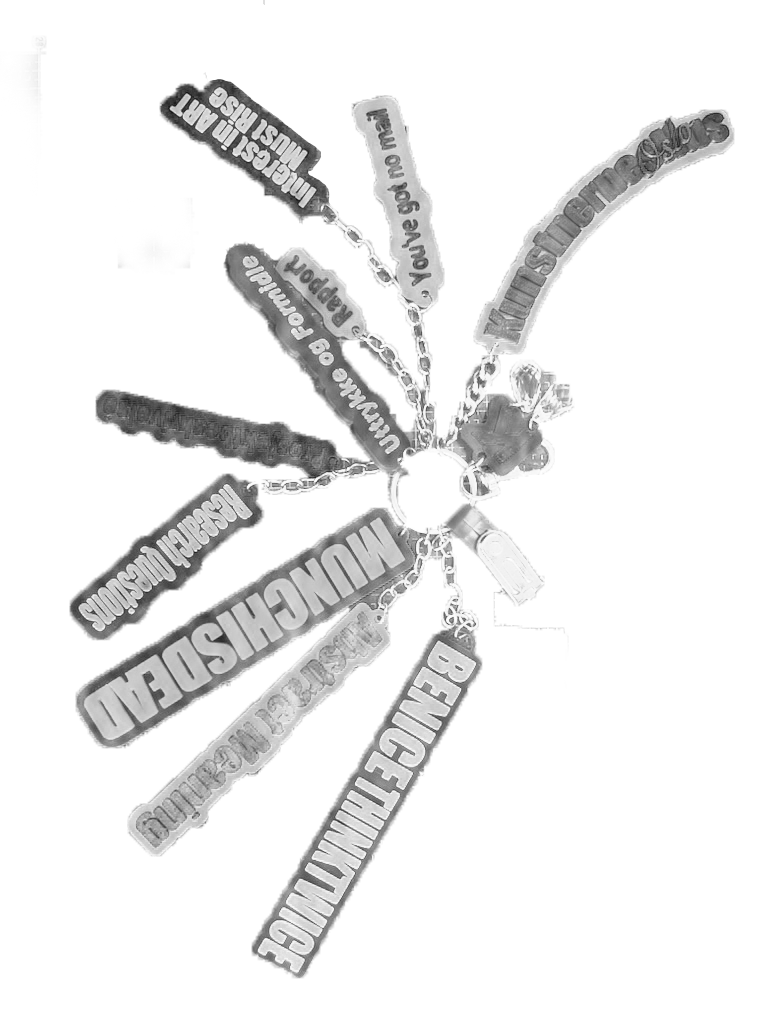
Productivity has become a measure by which we're taught to value ourselves. Yamamoto feels as if they are constantly battling the required tasks that take time away from making, applications, budgets, reports and an exploding inbox. By isolating common phrases from their administrative context, such as “Research Questions” and “Abstract Thinking,” Yamamoto surfaces the humour hidden in their absurdity. These slogans sit alongside wishful projections including “You've Got No Mail” and “Be Nice Think Twice,” together they become mantras to fight off modern-day monsters. Yamamoto’s body of text-based works turns language into a playful invitation for visitors to find their own words, and humour, for their lived experiences.
REQUIRED LABOUR:
- Wield humour as an act of resistance
- Contest productivity as a metric of worth
- Transform waste into material
IN THE ARTIST'S WORDS
I am always searching for a new quote or mantra—a phrase that helps me navigate the absurdity of contemporary life. These slogans appear across my practice in textiles, printmaking, and 3D-printed sculptures.
The 3D works grew from reflecting on the pressure to constantly produce, be efficient, and remain productive. As an artist, I spend as much time writing applications, budgets, reports, emails, and teaching as I do making art. By turning this language into sculptural objects, I reclaim it as a space for humor, resistance, and reflection.
Many of the sculptures are produced from recycled plastic waste from my own studio, transformed into new 3D-printing filament. Recent presentations include Portable at Luihn Gallery in Oslo and a series of slogan-based works developed for my exhibition You Are What You Is at MUNCH Museum, where language became a playful yet critical invitation for visitors to reflect on work, identity, and everyday life.
KIYOSHI YAMAMOTO
NOT YOUR
EXOTIC
NECKLACE
DETAILS
NOTES FROM THE CURATOR
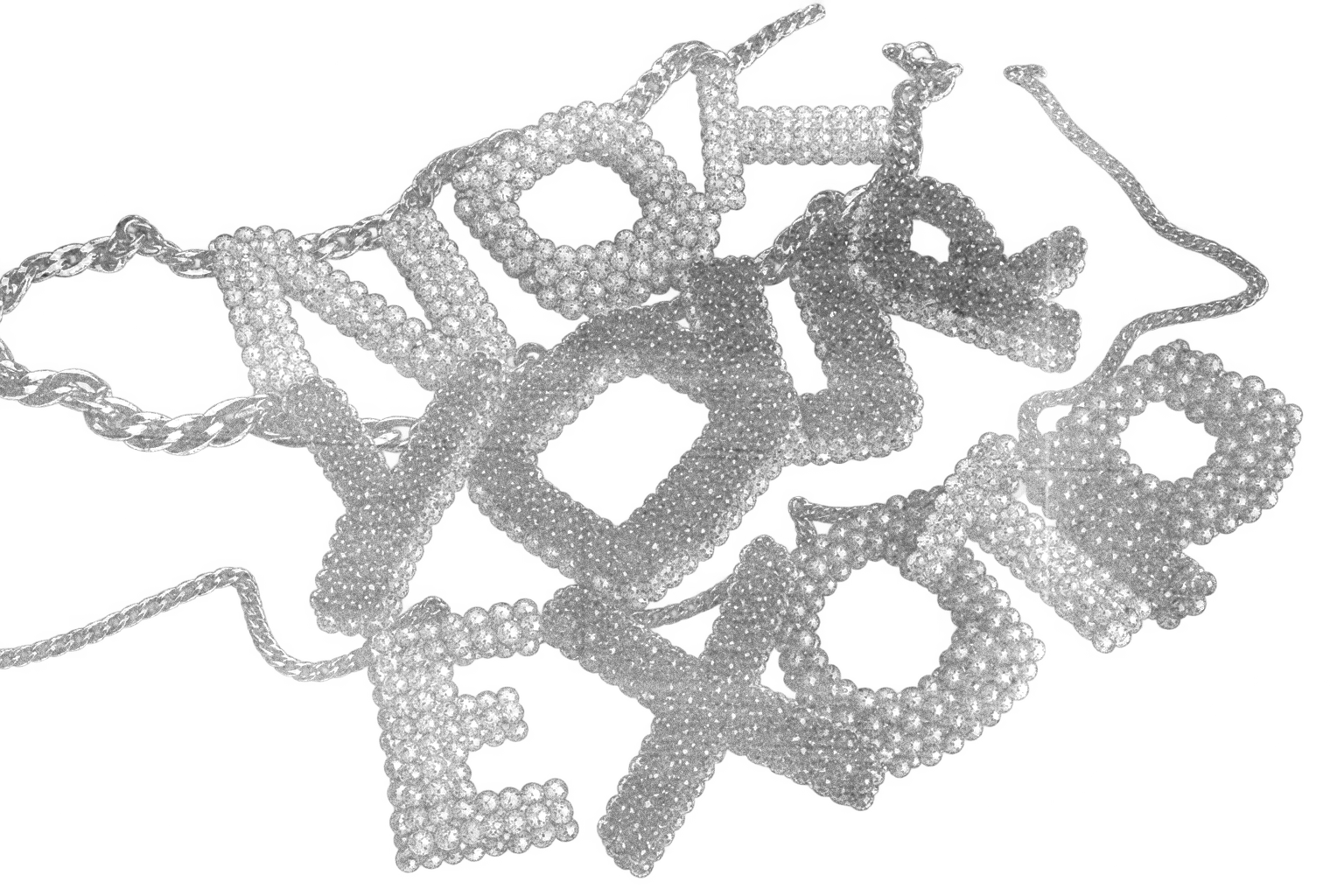
Drawing on their Brazilian heritage, Yamamoto brings beadwork into this text-based body of work. Not Your Exotic is three separate chains that come together to form its titular phrase, a structure that mirrors its message. To be hyphenated, whether in culture, gender, or sexuality, is framed as other, as something exotic, something foreign. Not Your Exotic brings together three separate strands to create space for something new, multihyphenate or something without a label. The beadwork continues part of Yamamoto’s practice that is focused on reuse, creating new meaning.
REQUIRED LABOUR:
- Navigate hyphenated identity
- Challenge cisnormativity and heteronormativity
- Transform waste into material
IN THE ARTIST'S WORDS
My beadwork explores colour, memory, and cultural identity through the rich traditions of Brazilian craftsmanship. I approach beading as a contemporary material practice, where each bead becomes a unit of colour and the slow process of hand stitching becomes an act of reflection.
Colour is never simply decorative; it carries emotion, heritage, and belonging. Through the accumulation of beads, I create tactile colour fields that exist between textile, sculpture, and painting.
I also use beadwork as a form of political expression, demonstrating how a material traditionally associated with decoration can become a tool for resistance and social engagement.
CURATED BY
GRACE LAI
ABOUT GRACE
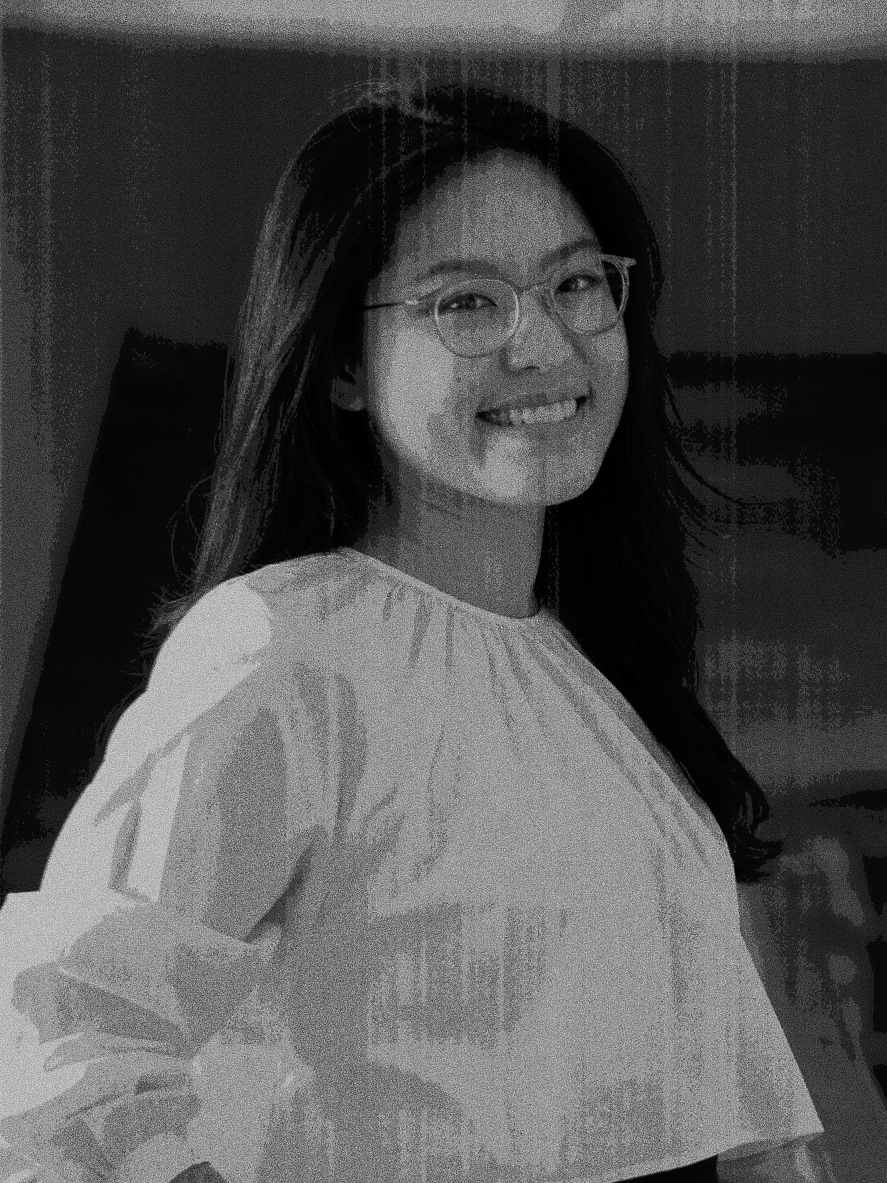
Guided by curiosity, art historian and curator Grace Lai is drawn to objects marginalised by dominant histories. Her research positions material culture as a lens for unravelling how value and meaning are constructed. She contributes reviews and essays to exhibition catalogues, journals, and magazines, with a focus on ceramics, glass, jewellery, and surface design. Her independent curatorial practice centers on creating immersive experiences that challenge unexamined assumptions and inherited perspectives, explored most recently in her Sweet Labour project. Her considered judgement has been drawn upon for international awards including Linda Peshkin AJF Solo Exhibition Award (United States), Ceramics NZ 61st Exhibition (Aotearoa New Zealand) and FUZE Glass Prize (Australia).
Grace is currently the Curator of Applied Arts and Design at Tāmaki Paenga Hira Auckland War Memorial Museum, where she stewards the development, research and exhibition of a nationally significant archive of craft that spans from the 1st century to present day. In her institutional role, she shapes critical exhibitions and reimagines legacy galleries - selected projects includes Carried Away: Bags Unpacked (2019), Arts of Asia: Beauty in the Everyday (2024) and Te Puna Whakarākei Jewellery as Statement (2025). These exhibitions reframe the collection to expand representation, interpretative narrative and contemporary craft discourse.
WHAT WOULD
YOU DO TO
COEXIST?
ACKNOWLEDGEMENTS
This exhibition was realised through the voluntary labour of the people who championed it. My thanks to the exhibiting artists, Mary Curtis, Victoria Edin, Jimmy Ma'ia'i and Kiyoshi Yamamoto, for their trust and generosity; Marta Costa Reis for the invitation and for couriering works; Carlos Silva for his on-location support; Ann Tozer, Frida Rusnak, Johanna Zellmer and Thereza Pedrosa for their feedback and enthusiasm; and Lola Ibanez for donating the bookshelf that forms the base of the display. Joy Lai and Daniel Dausch Ibanez were collaborators throughout – sharing the emotional, mental and physical labour required to build an idea from scratch.